A Sustainability Glossary to Clear Up Confusion (And a Word to Inspire)
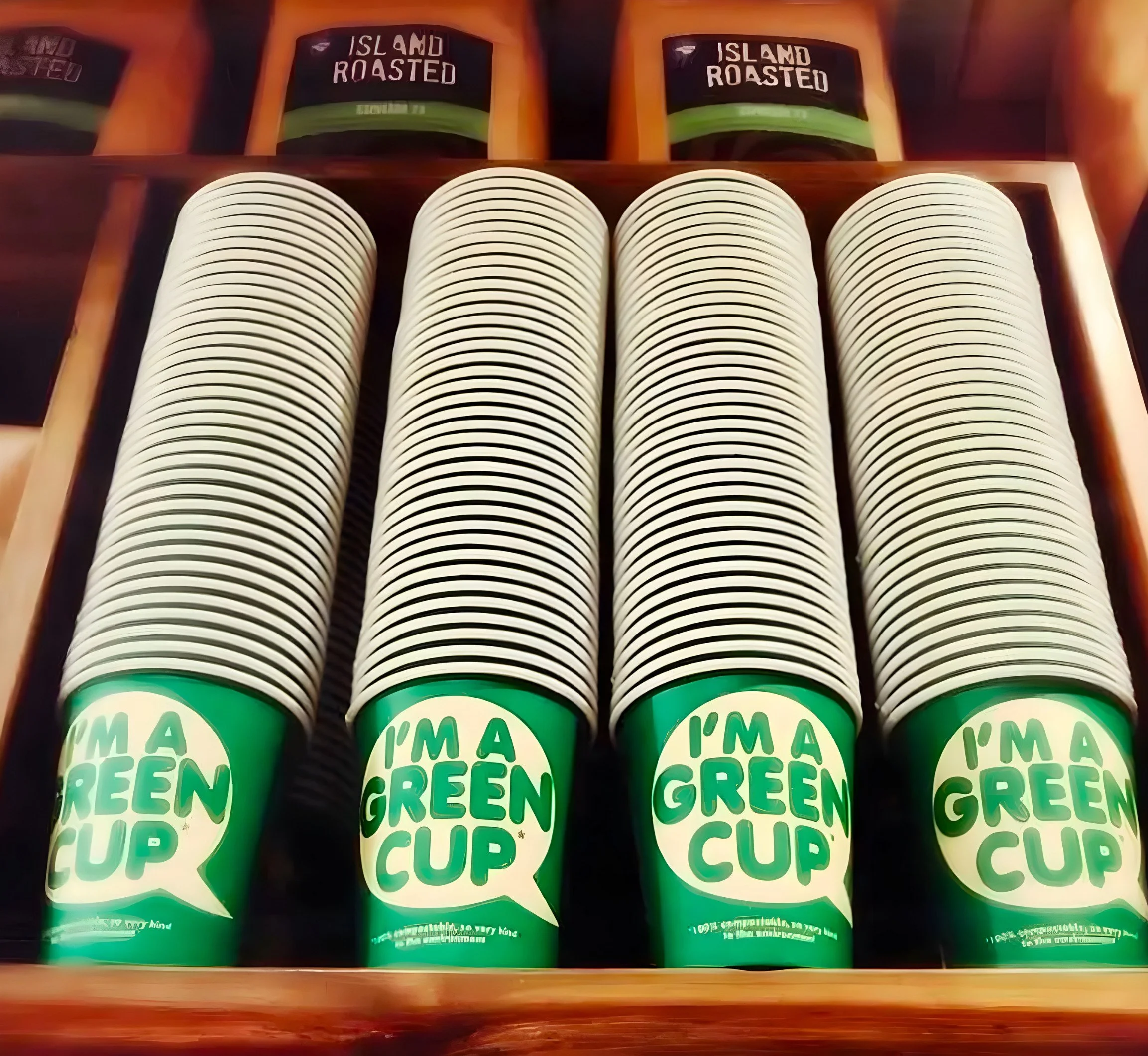
Four rows of green, recyclable cups clearly labelled I’m a Green Cup
Businesses doing good aren’t talking about it.
There's a particular kind of frustration I hear from businesses doing the right thing.
They've changed their suppliers. Rethought their packaging. Invested in technology and restructured processes to measure and monitor carbon footprint. Had the harder, slower, more expensive conversations. And made better choices anyway.
Because they care, genuinely, about what their business puts out into the world.
Then they say nothing. Very little. Recount something that lands with all the impact of a corporate sustainability report read aloud behind the porta-loos at a music festival. Or ask someone to help them write about it. (do that!)
What's fascinating is that invariably (in my experience) business leaders and marketing heads don't struggle to speak to stakeholders about their work - in fact they’re very animated and impassioned when they do - but they do struggle when it comes to writing about it. They don’t have the time, they don’t know where to start and they don’t want to be pilloried at dawn for getting it wrong.
Because then they really are transparent and accountable.
This lack of communication is totally fixable peeps. If you understand what's going on with sustainability language right now. And the attention companies and accrediting bodies are “quite rightly” giving to the written word.
So. Let's talk words.
The Sustainability Glossary of Terms: What's What (and What's Going Wrong)
The world of sustainability has developed a bit of a glossary. Some of it came from activists. Some from regulators. Some from scientists. Some from marketing departments hoping nobody will look too hard!
Here's what the green terms mean..
Greenwashing-Saying more than you do.
You've heard it, right? It's when an organisation is making environmental claims that aren't backed by any evidence. Meaningless (unsubstantiated) terms like: "Eco-friendly." "Sustainable." "Planet-conscious." "Responsible." You'll have spotted them on packaging, websites, press releases. What do they really mean? Images of green fields and wildlife-rich waterways spring to mind?
Greenwashing isn't necessarily always deliberate. Sometimes it's lazy shorthand or comes with the assumption that one phrase will be enough to prove to buyers that “all in their house is in order.” Either way, audiences have got wise to it, trust has taken a beating, and regulators are paying close attention.
The UK's Competition and Markets Authority (CMA) has been very clear: environmental claims must be truthful, accurate and substantiated. Vague terms like “eco-friendly” without evidence are a consumer law issue.
Across the Channel, the EU’s EmpCo Directive (2024/825), in force from September 2026, goes further still, explicitly banning generic green claims, with fines of up to 4% of EU turnover.
Greenhushing-Doing more than you say.
This is a quieter problem, and in many ways a more frustrating one. Greenhushing is when businesses doing genuinely meaningful work stay silent about it. Often in fear of being accused of greenwashing or looking like they're showing off.
But here's the thing: silence leaves a vacuum. And vacuums get filled; by competitors making louder claims (well-founded or otherwise), by misinformation and by audiences who don’t know who to trust.
Research suggests that most businesses who have scaled back public sustainability communication haven't actually scaled back their commitments. They've just gone quiet. Which means progress becomes invisible. So from the outside the businesses doing the right thing look exactly like the ones who've given up.
Good work goes unrecognised and audiences can't find the businesses they actively want to support.
GreenSHOUTING-Doing the right things and bellowing it from the rooftops.
A term coined by B Lab (behind the B Corp movement) and Creatives for Climate, green shouting is the antithesis of greenwashing. The claims are real. The actions are genuine. But is the communication always clear? Yes it calls for clear, transparent and confident. But in my world the following does NOT comply:
"We operate in accordance with a net-zero aligned supply chain framework with science-based targets across Scope 1, 2 and 3 emissions."
I mean. Good for you. But what does that mean to the person reading it?
I worry GreenSHOUTING treats sustainability communication like a compliance exercise. Tick the boxes, use industry terminology, be boisterous in your delivery and demonstrate you've done your homework. What it forgets is that human beings make decisions based on how something makes them feel.
The GreenSHOUTING guide promotes confident, clear communication but to do that you genuinely have to know and hear your reader.
If you use the language that only means something to you (the writer) then you risk your audiences glazing over, clicking away, or even worse, assuming you're hiding something behind the jargon.
Greenwishing-Making aspirational claims with no plan behind them.
"We're committed to becoming carbon neutral by 2040." Great. How? What are you changing? What's the plan?
Greenwishing is sustainability communication that lives entirely in the future tense, conveniently vague about what's happening today. It's not lying, exactly. It's just not saying anything either.
So when the deadline arrives and nothing's changed, the credibility fall is a hard one, from a multi-storey height.
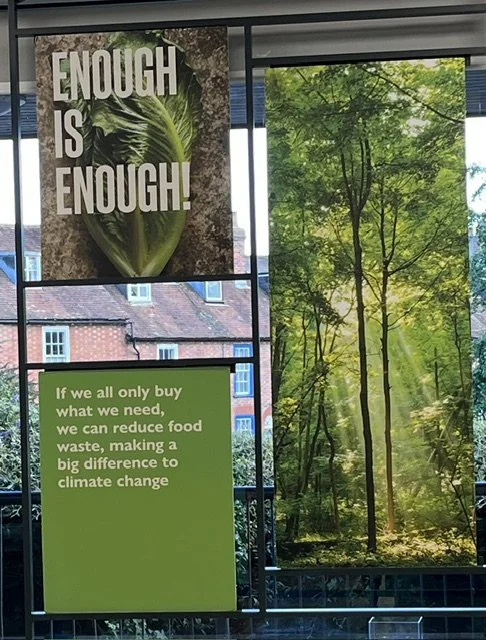
Three signs in a supermarket window, flagging how reducing food waste will make an impact on climate change.
Greenshifting - Moving the responsibility onto the customer.
"The sustainable choice is in your hands." "Together, we can make a difference, choose our eco option at checkout." This is greenshifting: a subtle (sometimes not so subtle) pivot that makes the consumer responsible for the environmental outcomes of a business's own operations and supply chain.
It's not the customer's job to fix your business model. Your audiences aren’t fools, they notice when they’re being patronised.
A prime example of this for me was the signage above the checkout at my local supermarket, implying I only buy the food I really need to reduce food waste, and then stocking 68+ choices in the biscuits and snacks aisles. (oh yes, I counted!)
Greencrowding - Hiding in the herd.
"As members of the Alliance of Commercial Writers, we’re committed to acting in the best interests of clients and conducting projects professionally.”
This is greencrowding, using collective or industry-wide commitments to imply individual action, without saying anything specific about what your business is actually doing.
There's safety in numbers, and that's precisely why it's used. Nobody has to stand out, be specific or accountable.
Don't lose heart with green terms, it's not all bad.
According to the Creatives for Climate and B Lab GreenSHOUTING Guide (2026), globally only 8% of companies have actually scaled back their sustainability commitments. 53% are holding steady. 32% are expanding them. That's 85% still doing the work.
But South Pole's Net Zero Report found that 81% of those same companies know communicating sustainability is good for their bottom line, yet over half are deliberately planning to be quieter about it.
And the Edelman Trust Barometer - an annual global survey of 125 countries - found that 53% of consumers interpret corporate silence as inaction or concealment.
So, most businesses are still doing the right thing. Most know they should talk about it. Write about it. And their customers are drawing exactly the wrong conclusion.
"Is no-one doing anything?"
That's not a sustainability problem. That's a communication problem.
So, I've coined a term to help us frame the language.
An inspirational, motivating green sustainability term #GREENSPIRING, introduced by sustainability copywriter Vicks Ward to encourage positive, transparent language around sustainability claims.
Greenspiring - Communicating your genuine sustainability commitments clearly and honestly in a way that inspires others to join in.
It doesn't drown out others but exists in the spirit of community and collective movement. The aim of Greenspiring is to inspire others to onboard fellow change-makers, share the work, the knowledge, the successes and failures so others can access the frameworks and decisions that work, with a view to making good progress faster. Dialing into the overused realms of - sorry, not sorry, but it's what I mean - COLLABORATION.
It's honest and clear and it sounds like this:
"We only work with florists growing British seasonal flowers. It costs us more. We think it's worth it."
Not:
"We operate a sustainable floral procurement strategy aligned with seasonal and local sourcing best practices."
Greenspiring trusts the audience. It says: here's what we do, here's why, here's what we haven't figured out yet. It just tells the truth, clearly, enough that people can act on it. Informed.
Why Clear Sustainable Writing Matters Now
Audiences have never been more literate about sustainability claims, and more sceptical of them. That's not cynicism, it's a reasonable response to years of greenwashing. But it creates a problem: the businesses doing the real work are getting lost in the noise made by the ones who aren't.
Clear, honest sustainability communication isn't just good ethics. It's good business. The customers, clients and collaborators actively looking for businesses like yours can't find you if you're either hiding or talking in code.
You don't need to have solved everything. You don't need a perfect carbon footprint and a B Corp certification and a zero-waste supply chain before you're allowed to open your mouth. You need to be honest about what you're doing, where you're heading, and what you're still working out. That's it. That's greenspiring.
And I can show you what that looks like in words for you, just book a quick call.
Where Vicks Comes In
I'm a freelance copywriter. I write for businesses doing good in the world: B Corps, impact-led brands, and businesses that share their values, whatever their sector.
I help businesses find the plain, powerful language for the work you're already doing. Words that your audience will read, understand, remember, and respond to.
If you're doing the right thing and struggling to say so, clearly, confidently and without the green vague-ry, let's talk.
If you’d like help with your marketing comms subscribe to The Wardroom for copywriters’s gold-dust.
Vicks Ward is a freelance copywriter with 30 years' marketing experience and 10 of them copywriting for brands doing good in the world. She writes websites, impact reports, blogs, case studies, press releases, newsletters and more, in your voice, not hers.